
In diseases such as cancer and osteoporosis, abnormalities in cell proliferation, differentiation, cell death, and cell-cell interactions play important roles. Understanding and discovering small-molecule compounds, nutrients, and endogenous substances that regulate these cellular functions is important not only for elucidating disease mechanisms but also as a starting point for developing new therapeutics.
Our laboratory focuses on small-molecule compounds, nutrients, and endogenous substances that exhibit anticancer activity or regulatory effects on bone metabolism, and searches for molecules that control disease-related cellular functions. For candidate molecules, we analyze their effects on cancer cell proliferation, cell death, and the cell cycle, as well as their effects on osteoclast differentiation and bone resorption, while working to clarify their mechanisms of action.
Through these studies, we aim to identify compounds and endogenous substances that control cellular functions involved in cancer and bone metabolism disorders, and to obtain basic knowledge that can contribute to drug discovery and disease treatment.
References
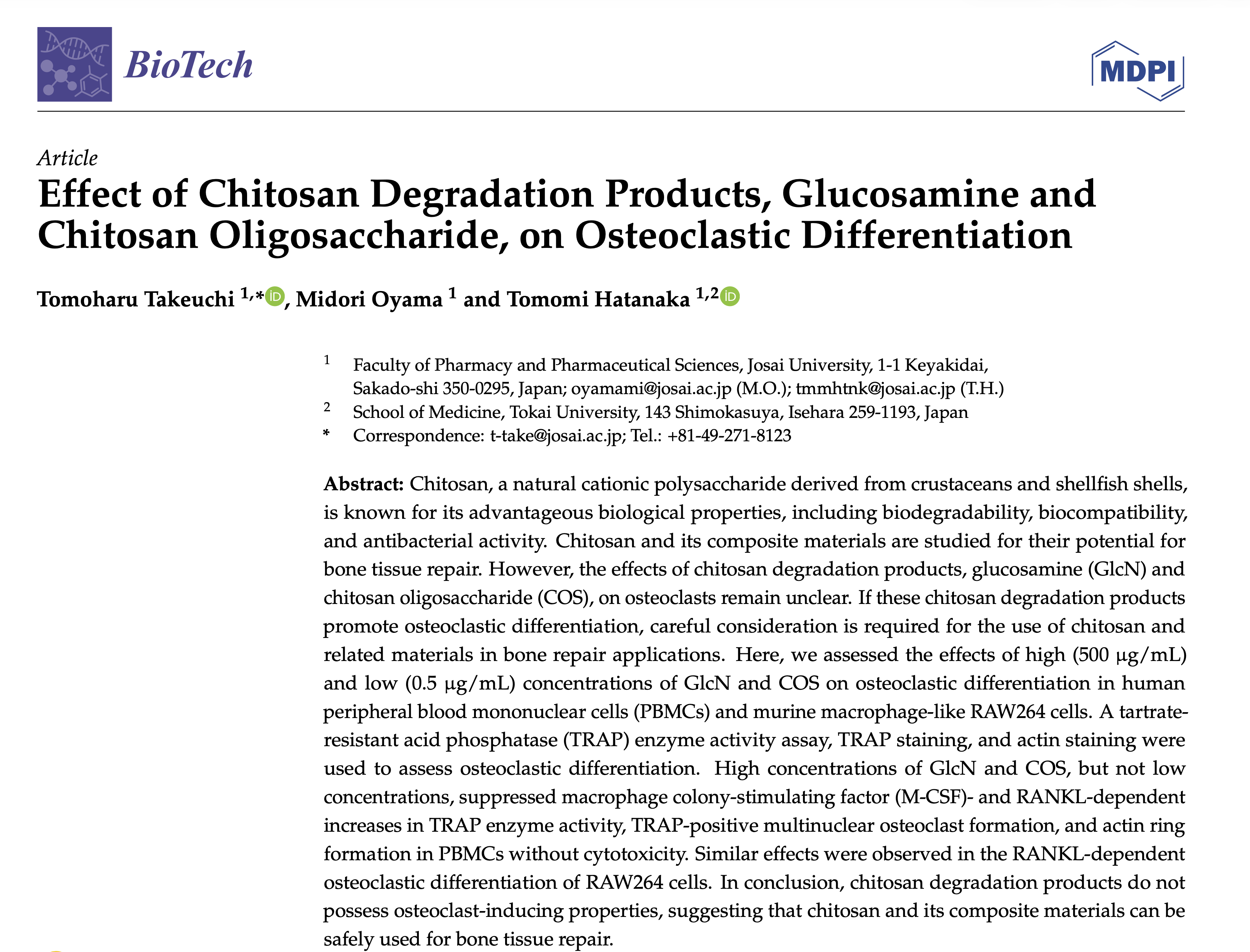
- Effect of Chitosan Degradation Products, Glucosamine and Chitosan Oligosaccharide, on Osteoclastic Differentiation
Takeuchi T, Oyama M, Hatanaka T.
BioTech (Basel). 2024;13(1):6. - Osteoclast Differentiation Is Suppressed by Increased O-GlcNAcylation Due to Thiamet G Treatment
Takeuchi T, Horimoto Y, Oyama M, Nakatani S, Kobata K, Tamura M, Arata Y, Hatanaka T.
Biol Pharm Bull. 2020;43(10):1501-1505. - Glucosamine Suppresses Osteoclast Differentiation through the Modulation of Glycosylation Including O-GlcNAcylation
Takeuchi T, Sugimoto A, Imazato N, Tamura M, Nakatani S, Kobata K, Arata Y.
Biol Pharm Bull. 2017;40(3):352-356. - Halenaquinone inhibits RANKL-induced osteoclastogenesis
Tsukamoto S, Takeuchi T, Kawabata T, Kato H, Yamakuma M, Matsuo K, El-Desoky AH, Losung F, Mangindaan RE, de Voogd NJ, Arata Y, Yokosawa H.
Bioorg Med Chem Lett. 2014;24(22):5315-5317.