
Glycans are important molecules that cover the cell surface and are deeply involved in cell-cell interactions and in how cells recognize their surrounding environment. Galectins are glycan-binding proteins that recognize and bind to glycans, and they are known to participate in a wide range of biological phenomena and diseases, including cancer, immunity, inflammation, and bone metabolism.
Our laboratory focuses especially on galectin-1 and studies its effects on cancer cell proliferation, migration, and cell-cell interactions in the tumor microenvironment. In bone metabolism, the balance between bone resorption by osteoclasts and bone formation by osteoblasts is essential, and disruption of this balance can lead to osteoporosis and frailty. We have shown that galectin-1 suppresses osteoclast differentiation, and we are now working to clarify the molecular mechanisms involved and identify galectin-1 ligands on the osteoclast surface.
Through these studies, we aim to clarify how glycans and galectins regulate cancer malignancy and bone metabolism, and to obtain knowledge that can serve as a foundation for new disease-control strategies.
References
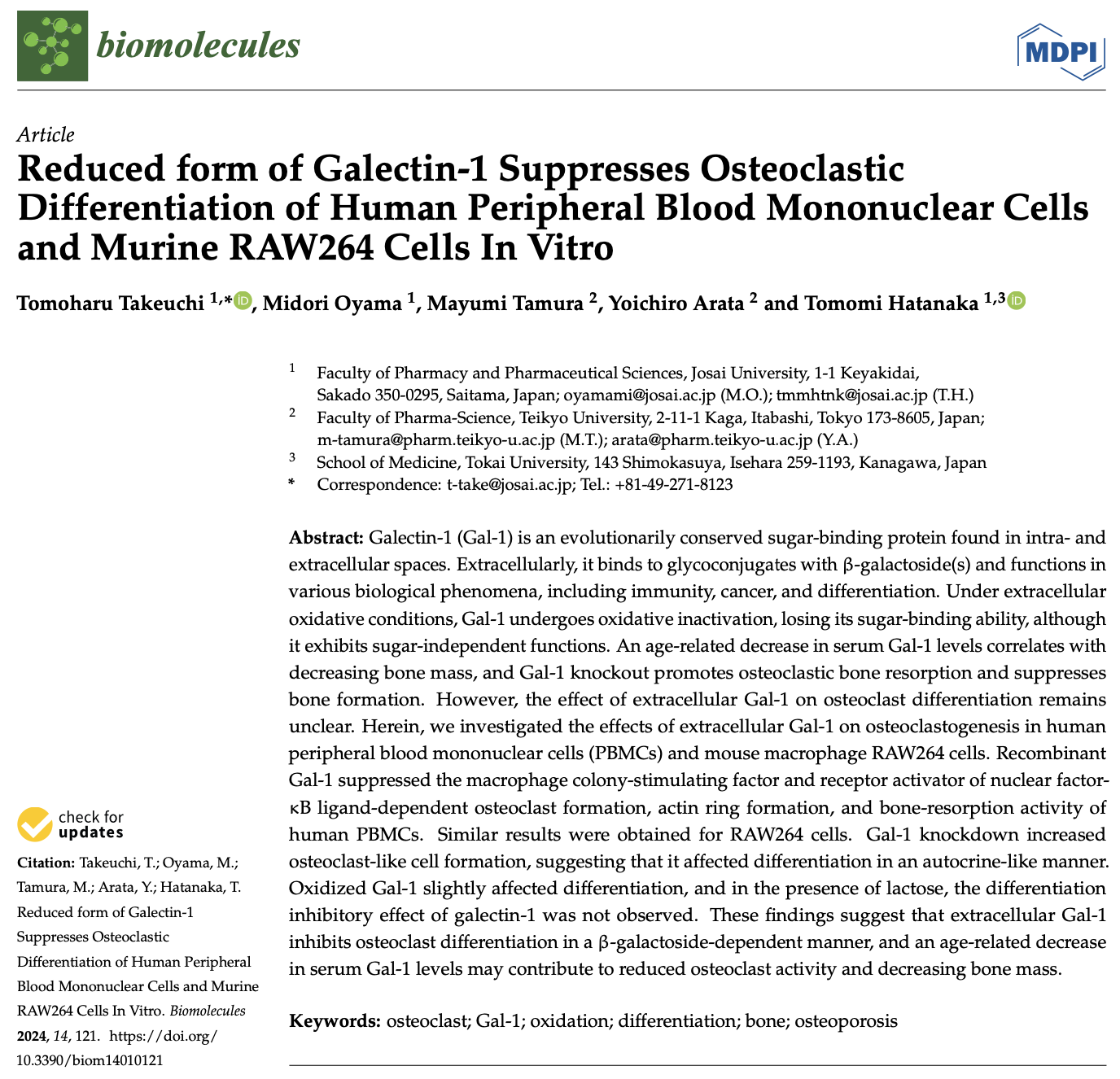
- Reduced form of Galectin-1 Suppresses Osteoclastic Differentiation of Human Peripheral Blood Mononuclear Cells and Murine RAW264 Cells In Vitro
Takeuchi T, Oyama M, Tamura M, Arata Y, Hatanaka T.
Biomolecules. 2024;14(1):121. - Preparation of recombinant galectin protein: expression, affinity purification, and removal of lipopolysaccharide
Takeuchi T.
Glycoscience Protocols (GlycoPODv2). 2021. - Mammalian galectins bind galactoseβ1-4fucose disaccharide, a unique structural component of protostomial N-type glycoproteins
Takeuchi T, Tamura M, Nishiyama K, Iwaki J, Hirabayashi J, Takahashi H, Natsugari H, Arata Y, Kasai K.
Biochem Biophys Res Commun. 2013;436(3):509-513.